


Marpisses VERAELIAKONSTANZAFRANCKLEE* – Art Exhibition as part of the Routes in Marpissa Festival 2026
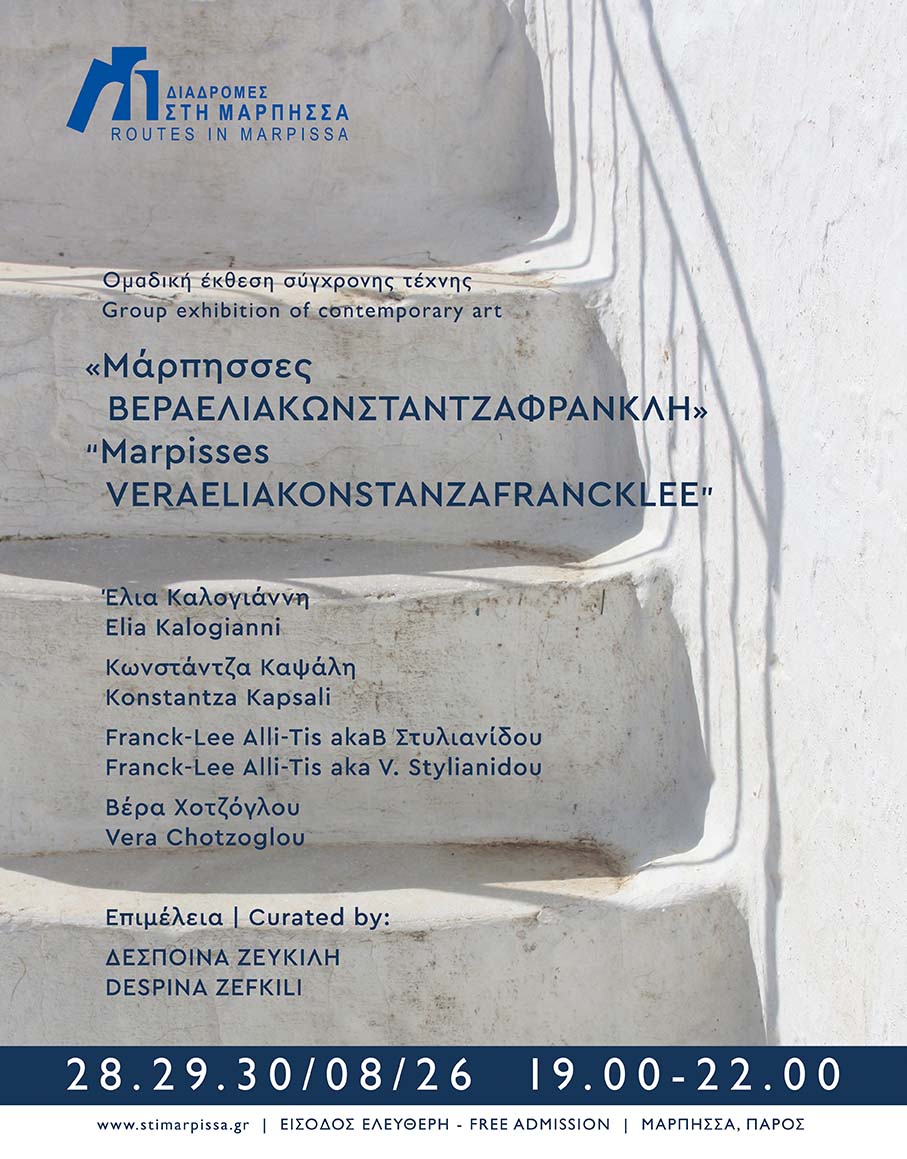
Marpisses
VERAELIAKONSTANZAFRANCKLEE*
Art Exhibition as part of the Routes in Marpissa Festival 2026
Artists: Elia Kalogianni, Konstanza Kapsali, Franck-Lee Alli-Tis aka V Stylianidou, Vera Chotzoglou
Curator: Despina Zefkili
“While you’re waiting for me to prove something, I hold tightly to my right to self-determination. I am whatever I choose to be. In the past, I would have easily fallen into your trap. I would have tried. I would have bled. Now I’m carrying explosives for social constructs. A man approaches me; I recognize in his face someone I once knew. ‘You’ve changed,’ he says. ‘Call me a Story,’ I reply.”
Georgia Tempridou, Short Story, Akyvernites Politeies Editions, 2023.
Women of different generations play a game of Coon Can with a man at the KAPI (Senior Citizens’ Centre) of Marpissa, claiming their right to carefree joy. Women of different ages write and perform a work about a newly emerging collective of hybrid cyborg bodies born on the island after the storm (of tourism?). A young shepherd milks her goats. An elderly woman recalls her childhood, when every Sunday the women of the village carried tables out of their homes and set them up in the street, transforming it into a shared space for meals and togetherness. What will the rain of milk bring? And what of the rain-soaked bodies? What conversations unfold around the table at the KAPI, and what around the one set out in the village square?
Is Marpissa feminine?
Looking back at the works created over the years as part of the Routes in Marpissa Festival exhibitions, one cannot fail to notice that the women of the village have always occupied a central place. Sometimes through the artists’ direct collaboration with women’s associations and community groups, and at other times through a return to figures, customs, and lives from the past—or even from myth.
“A stern face with heavy eyelashes and two swollen marks—breasts, no doubt—and a stance with one hand resting at the side; the figure appears both male and female. But what delight there is in her expression…” we read in the description of one of the votive offerings documented by the folklorist Zacharias Stellas in his book Paros: Clumsy Drawings (1975).
Engaging in dialogue with this year’s festival theme, Korai, the exhibition VERAELIAKONSTANZAFRANCKLEE* seeks out female stories that inspire us, relationships that help us break free from the boxes that confine us (“boy or girl?”), confront both trauma and wonder, reshuffle and redistribute words, and hold tightly to our right to self-determination.
Through site-specific research on the island, conversations with its women residents, and a search for intergenerational, plural forms of kinship that—even when they create moments of disruption—also act as forces of healing, reconciliation, and empowerment, the visual artists VERAELIAKONSTANZAFRANCKLEE carry “explosives for social constructs,” along with materials—soft and hard alike—for affective constructions: the structures we build in order to inhabit the world with safety, acceptance, and freedom, and ultimately, to exist.
*The exhibition title references Glykeria Basdeki’s poem NANATZENIFRINTAERSIMARIAVERONIKI.
The Works
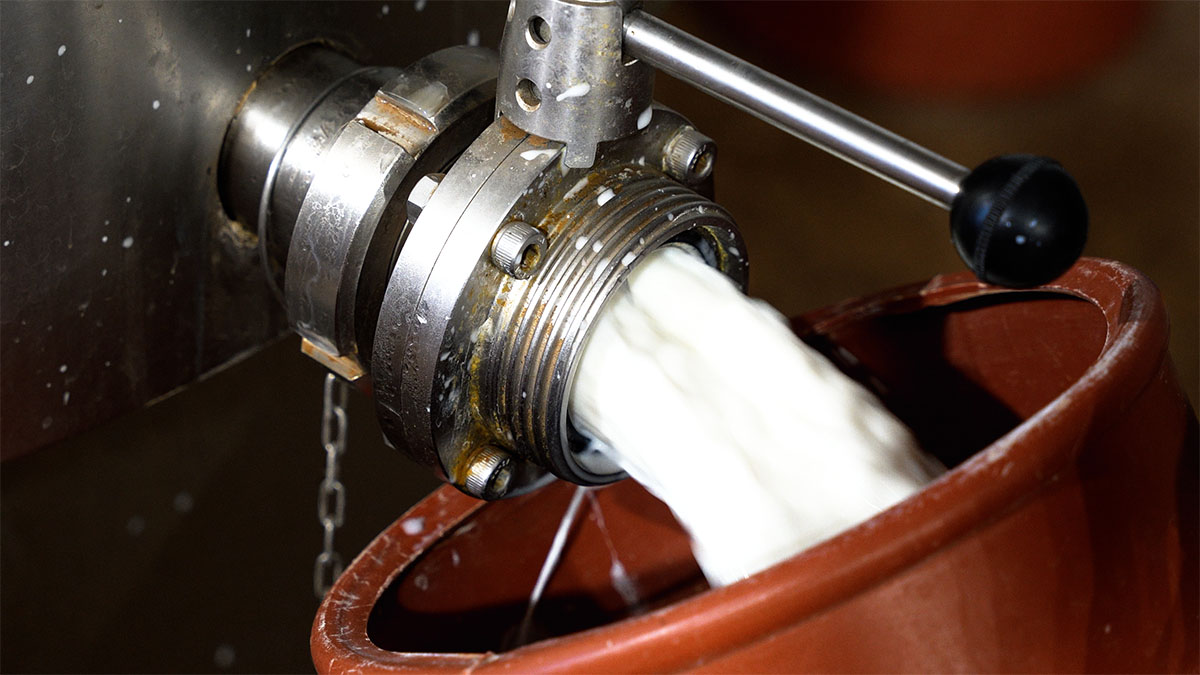
Elia Kalogianni, Lactating Bodies, 2026, video installation.
The work examines the practice of milking as a site where different forms of femininity, reproductive labour, and interspecies relations converge. Filmed at the Parion family dairy in Marpissa, the video follows a young woman operating a mechanical milking system, collecting milk from female goats, which is subsequently transformed into cheese. Through the rhythmic repetition of labour and the mediation of technology, the work explores the relationships between human and animal bodies, presenting milking as a process in which care, production, and automation become inseparable.
Milk, as both a primary source of nourishment and a carrier of reproductive value, functions as connective tissue linking bodies, species, and economies, revealing the ambivalent conditions that shape the production process. Rather than adopting a binary reading of care and exploitation, the work approaches milking as a field of interdependence in which intimacy, labour, technology, and productivity jointly shape the relationships between human and more-than-human bodies. Through this encounter, questions emerge concerning the multiple manifestations of femininity, reproductive labour, and value within the context of contemporary agricultural production.
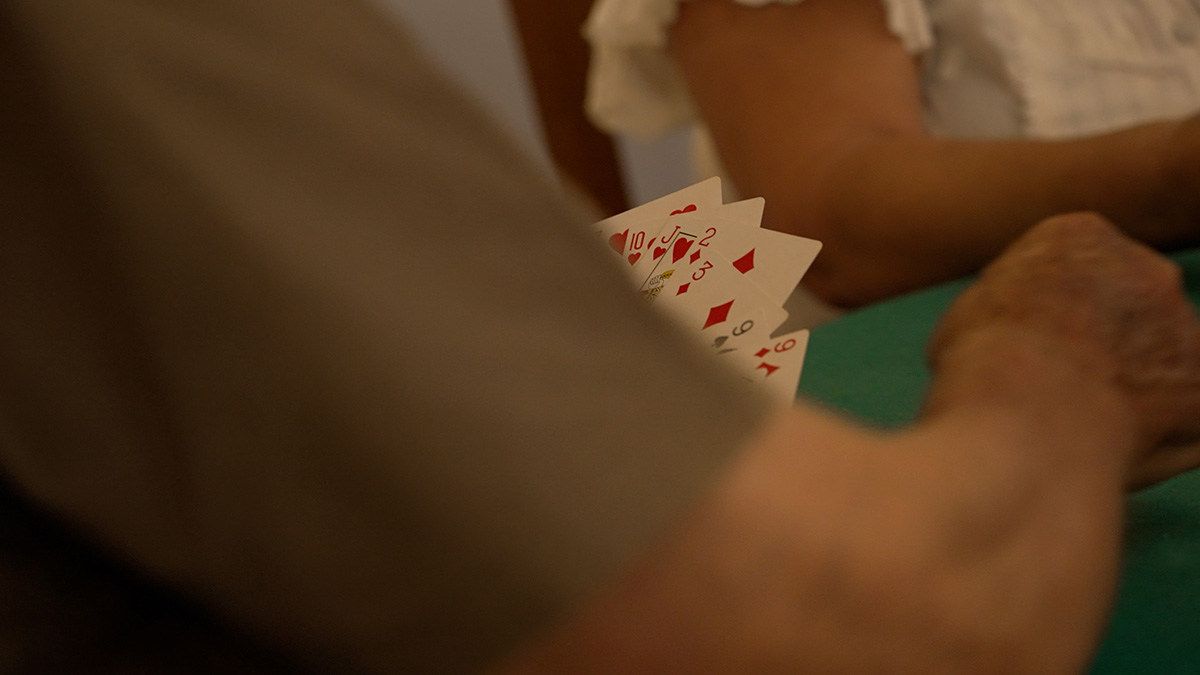
Konstanza Kapsali, Coom Can, 2026, single-channel video, HD, stereo.
One afternoon at the KAPI (Senior Citizens’ Centre) of Marpissa, three women and one man of different generations play a game of Coon Can. The film follows the game, the gestures, and the everyday conversations that unfold around it, exploring whether we can view older people through the prism of carefree joy, humour, and desire.
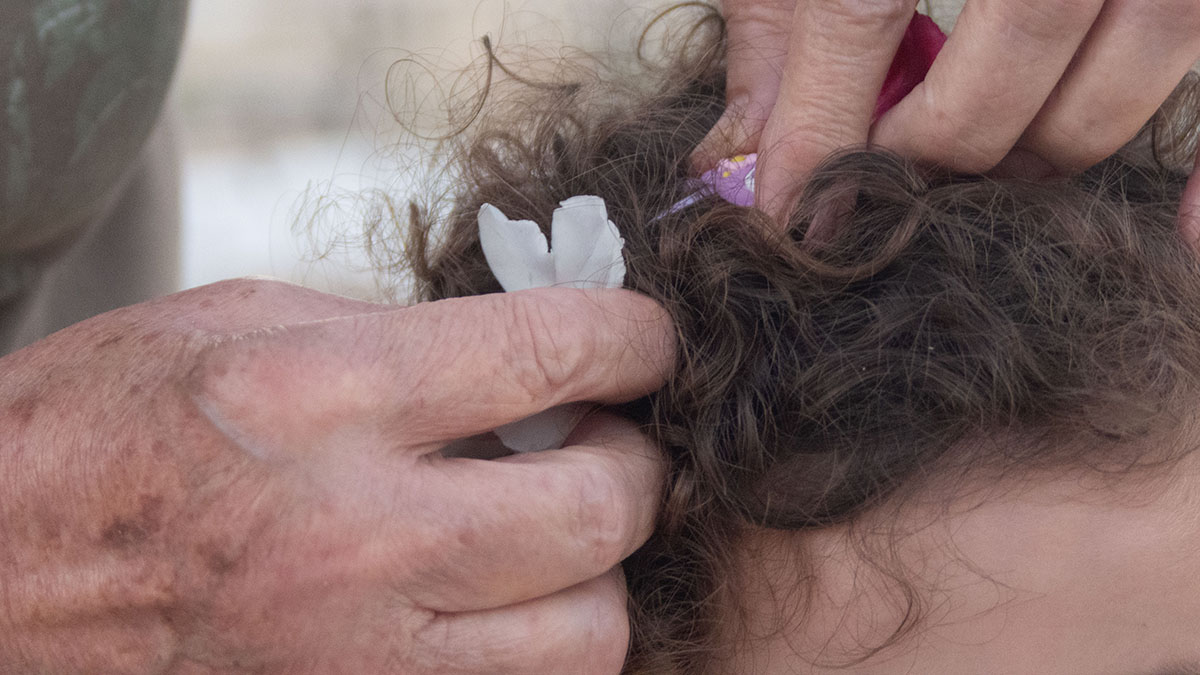
Vera Chotzoglou, A Table Beneath the Night Sky, 2026, installation.
The installation is based on the oral testimony of M., a resident of Marpissa, and her memories of childhood, when every Sunday the women of the village carried their tables out of their homes and set them up in the street, creating a shared space for meals, conversation, and communal life. The work focuses on this small, recurring gesture as an act of encounter, sociability, and women’s social participation. The movement of the table from the private into the public realm becomes a transformative act: the street turns into a courtyard, the neighbourhood into a community, and the personal into the collective. The installation creates a space of listening and remembrance, centred on a sound composition based on M.’s oral testimony.
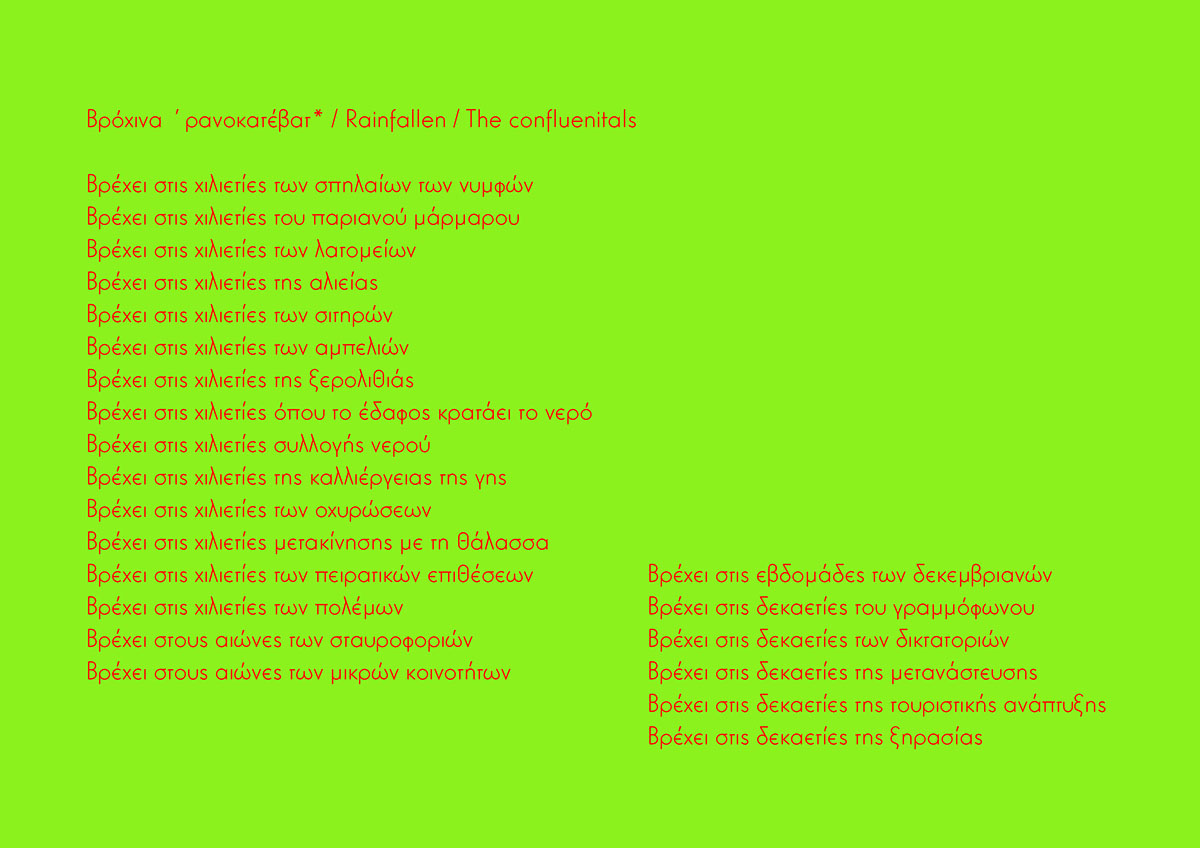
Franck-Lee Alli-Tis aka V Stylianidou, Rainfallen/The Confluentials*[1], 2026, installation–performance.
Drawing on the archive of oral histories created by the Routes in Marpissa Festival team, together with site-specific research conducted in the village, the work departs from the contemporary reality of Paros, where the intensification of tourism development is violently transforming the landscape, labour relations, and forms of collective life.
Within the framework of a speculative narrative, a powerful storm gives rise to a collective of hybrid cyborg bodies on the island. These are rain-born bodies—condensations of water, heterogeneous materialities, traces of memory, traditional tools, and fragments from multiple temporalities. Their skin bears the marks of human and geological layers, technological remnants, oral narratives, and future possibilities. Their presence opens a rupture in the linear perception of time: past, present, and future emerge as converging flows that pass through one another, continually transforming the possibilities of the present.
Comprising a speculative poetic narrative, a sound work, and a performance, the project proposes a different understanding of time—not as a neutral framework within which events unfold, but as a relation produced through the material, ecological, and political entanglements of bodies, places, and narratives. The future does not appear as a distant horizon; rather, it is continually reconstituted as a space through the interweavings and connections of what has already existed and what is still in the process of becoming.
[1] The word originates from Zacharias Stellas’s book Paros: Myths, Fairy Tales and Other Folklore and Linguistics. The asterisk in the title refers to the expanded linguistic practices of queer communities, where the removal of a word’s gendered ending functions as a way of moving beyond the gender binary while embracing multiple gender expressions. In Greek, the omission of the final vowel is also a familiar feature of many local dialects, reflecting both orality and linguistic economy. In this way, a traditional local linguistic practice enters into dialogue with a contemporary queer politics of language.
[2] The concept of confluential derives from the work of Antonio Bispo dos Santos, a Brazilian Quilombola thinker and activist, and constitutes a central concept in his anti-colonial thought. Confluential describes the coming together of different forms of knowledge and cultures that flow alongside one another and remain in dialogue, without relations of domination that would lead to a single, homogeneous form of fusion.